

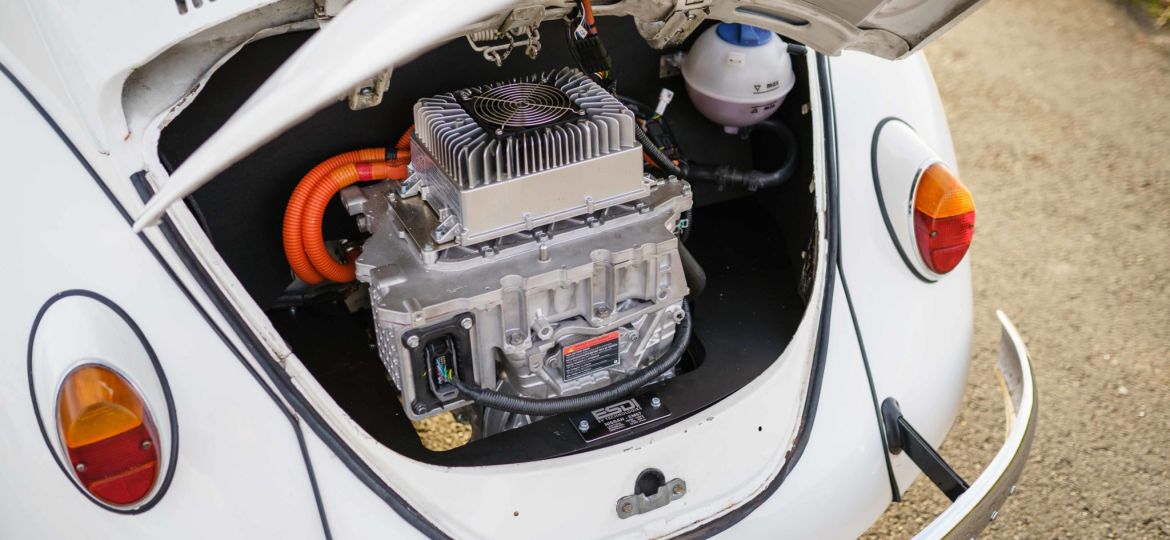
The VW Beetle is the most frequently converted vehicle in the German electric-conversion scene. That's no surprise: with just 800 to 900 kg kerb weight, simple mechanics and a huge fan community, it offers the perfect basis for an electric project. Whether you are looking for an affordable kit entry point or want a turnkey electric Beetle — this guide shows you all the options, real-world figures and what matters for TÜV registration.
Want to understand the big picture first? Our complete guide to electric car conversion explains the basics.
TL;DR: A VW Beetle electric conversion ranges from a DIY kit to over €60,000 (turnkey). The battery makes up 40–60% of total costs (emobility.energy, 2025). Ranges of 120 to 300 km are realistic. Tesla Small Drive Units have become the standard drivetrain. The Beetle loses its H-plate on conversion; motor-vehicle-tax exemption: not to be expected (no ABE for conversion parts, § 3d KraftStG) — E-license plate and THG bonus: yes.
Why is the VW Beetle so well suited to electric conversion?
With its 800 to 900 kg kerb weight, the Beetle brings ideal conditions for electrification. For comparison: a modern VW ID.3 weighs over 1,800 kg. Less weight means more range per kilowatt-hour — and that is exactly what makes the Beetle one of the most rewarding candidates for an electric conversion.
Low weight, big advantage
Heavy vehicles need large, expensive batteries. On the Beetle, 20 to 40 kWh are already enough for everyday range. A conversion with 30 kWh delivers around 150 to 200 km — enough for the daily commute. The light body also spares the tyres and brakes.
Simple mechanics without electronics chaos
Older Beetles have no control units, no ABS and no electric power steering. That simplifies the conversion enormously. The air-cooled boxer engine sits in the rear — a compact electric unit fits perfectly there. Wiring harnesses are manageable, and spare parts for chassis and bodywork are available everywhere.
Which models are best suited?
The 1302 and 1303 models (built 1970–1975) are considered the first choice. Their front-axle design with MacPherson struts offers more room in the front for the battery. Older Beetles with a swing axle also work, but offer less storage space. The 1303 additionally has a panoramic windscreen — a class of its own visually.
Anyone who finds a Beetle with structural damage to the floor pan should be careful. Housing the battery requires a solid floor pan. Rust on the longitudinal members or in the wheel arches can quickly drive up the conversion costs, because bodywork restoration is needed first.
What does a VW Beetle electric conversion cost?
The price range runs from a bare DIY kit to over €60,000 for a turnkey vehicle. According to emobility.energy (2025), 40–60% of the total cost goes to the battery — by far the largest item. Your budget determines how much range and comfort you get.
You'll find all pricing details in our cost guide for the electric conversion.
Cost tiers at a glance
| ESDI tier | Kit (excl. installation) | Turnkey (excl. base vehicle) | Key data |
|---|---|---|---|
| PURE | 29.990 € | 34.990 € | bis zu 100 kW, 25 kWh, bis zu 150 km |
| PERFORMANCE | 39.990 € | 44.990 € | bis zu 220 kW, 40 kWh, bis zu 300 km, 50 kW CCS |
| ULTIMATE | on request | on request | bis zu 450 kW, bis zu 48 kWh, bis zu 350 km, 70 kW CCS |
Why the battery dominates everything
A 20 kWh lithium battery costs between €4,000 and €8,000. At 40 kWh the price roughly doubles. Used Tesla modules can be cheaper, but quality assurance is laborious. Saving on the battery means saving in the wrong place — range and service life depend directly on it.
You'll find more on battery selection in the battery guide for electric conversion.
Hidden costs many people forget
Budget additionally for items not included in any kit price: the TÜV fees for the expert report and individual approval, bodywork, paint and small parts. A suitable heating solution – the combustion engine no longer provides warmth – also costs €500 to €1,500 extra.
The ESDI kits for the Beetle
ESDI EV Technologies
The Herford-based provider relies on Tesla drive units with its own purpose-built control electronics (ECU) and TÜV-accompanied kits. Three kit tiers are available: PURE from €29,990 kit price (up to 100 kW, 25 kWh; turnkey €34,990), PERFORMANCE for €39,990 kit price (up to 220 kW, 40 kWh; turnkey €44,990) and ULTIMATE on request (up to 48 kWh).
Which components does an electric Beetle need?
The core of every electric Beetle consists of five main components: electric motor, battery, inverter, battery management system (BMS) and onboard charger. The battery alone accounts for 40–60% of the total cost (emobility.energy, 2025). The Tesla SDU (Small Drive Unit Rear) with up to 220 kW peak power at only 75 kg weight has established itself as the motor.
Our comparison provides background on motor choice: AC vs. DC motor for electric conversion.
Tesla Small Drive Unit: the standard drivetrain
The Tesla SDU combines motor, inverter and gearbox in one compact housing. On the Beetle it is coupled via an adapter plate to the existing gearbox or directly to the rear axle. Global spare-parts availability is a big plus — Tesla parts are available worldwide.
Why not just fit a cheap Chinese motor? Because OEM drivetrains from production vehicles have millions of test kilometres behind them. Their reliability is documented, and TÜV inspectors know the technology. That saves an enormous amount of time and stress during the approval process.
Battery: LiFePO4 or NMC?
Two battery types are suitable for the Beetle. LiFePO4 cells (lithium iron phosphate) are safer and longer-lasting, but heavier. NMC cells (as in Tesla modules) offer more energy density at less weight — ideal for the weight-sensitive Beetle. The choice depends on the available space and the budget.
Our comparison explains the differences: detailed battery comparison LiFePO4 vs. NMC.
BMS and control electronics
The battery management system monitors every single cell — voltage, temperature, state of charge. Without a functioning BMS you risk fire hazards and rapid capacity loss. High-quality kits come with a matched BMS. Anyone assembling individual components must work particularly carefully here.
How much power and range are realistic?
Depending on configuration, an electric Beetle achieves 120 to 300 km of range. The weight after conversion typically rises to 1,050 to 1,200 kg — around 200 to 300 kg more than the original. The following table shows what the ESDI configurations deliver in concrete terms.
ESDI Beetle kits: Pure vs. Performance vs. Ultimate
| Property | Pure (€29,990) | Performance (€39,990) | Ultimate (on request) |
|---|---|---|---|
| Drive | Tesla Drive Unit | Tesla Drive Unit | Tesla Drive Unit |
| Power | up to 100 kW (136 hp) | up to 220 kW (300 hp) | on request |
| 0–100 km/h | approx. 6 seconds | approx. 4.1 seconds | approx. 3 seconds |
| Battery | 25 kWh | 40 kWh | up to 48 kWh |
| Range | up to 150 km | up to 300 km | up to 350 km |
| AC charging | 10 kW | 10 kW | 10 kW |
| DC charging (CCS) | — | 50 kW | 70 kW |
| Delivery | Kit or turnkey (+€5,000) | Kit or turnkey (+€5,000) | on request |
The PURE variant from €29,990 is suited to weekend outings and short commutes – and is available as a self-installation kit or turnkey for €34,990. Anyone who wants to use the Beetle as a daily companion goes for the PERFORMANCE at a kit price of €39,990 (turnkey €44,990) with CCS fast charging at up to 50 kW. The ULTIMATE variant (power on request) is for enthusiasts who want the maximum.
How does the installation work in practice?
A typical Beetle conversion takes between 40 and 80 working hours — equivalent to one to two weeks of full-time work at the workshop. An experienced workshop manages routine conversions at the lower end of that range. For first projects in your own garage, you should plan for considerably more time.
You'll find more on the pros and cons of DIY vs. workshop in our DIY guide.
The main work steps
- Disassembly: Remove the combustion engine, tank, exhaust and clutch. On the Beetle this is comparatively quick — four bolts hold the engine.
- Make the adapter plate: The interface between electric motor and gearbox (or direct drive). With kits it is supplied.
- Mount the motor: Attach the Tesla SDU or another e-motor to the adapter plate and position it in the rear.
- Install the battery: Place modules in the front (former luggage compartment) and/or under the rear seat. The mounting must be crash-safe.
- High-voltage wiring: Connect the battery, BMS, inverter and charger. Strict safety regulations apply here.
- Adapt the low-voltage system: Couple the dashboard, lighting and horn to the new 12V system.
- Retrofit heating: Install an electric auxiliary heater or parking heater — the Beetle no longer has engine heat.
- Test drive and fine-tuning: Configure the software, set up regeneration, check driving behaviour.
Typical time required by area
| Work step | Hours (estimated) |
|---|---|
| Combustion engine removal | 4–8 |
| Motor and gearbox mounting | 8–12 |
| Battery installation and mounting | 10–16 |
| High-voltage wiring | 8–14 |
| Low-voltage and control electronics | 6–12 |
| Heating, comfort, finishing | 4–8 |
| Testing and fine-tuning | 4–10 |
| Total | 44–80 |
What happens to the historic (H) plate after conversion?
With the electric conversion your Beetle loses its H-plate. The historic plate requires a largely original condition — an electric drivetrain contradicts that. Instead you can apply for an E-plate. You should not expect the motor-vehicle-tax exemption for purely electric vehicles, since it requires an ABE for the conversion parts (legal position: ADAC, Dec 2025).
You'll find everything about the inspection process in our guide to TÜV individual approval for electric conversion.
H-plate vs. E-license plate
| Aspect | H-plate | E-license plate |
|---|---|---|
| Vehicle tax | Flat rate €191.73/year | Exemption not to be expected (no ABE), the main customs office decides |
| Low-emission zones | Exempt | Exempt |
| Requirement | Largely original condition | Purely electric drive |
| Insurance | Cheap classic-car tariffs | Standard tariffs (sometimes more expensive) |
In addition, the affordable classic-car insurance tariffs fall away. Get comparison quotes before you decide.
What must be considered at the TÜV?
Every electric conversion in Germany needs a TÜV individual approval under §19 and §21 StVZO. The inspector assesses operational safety, electromagnetic compatibility (EMC) and the crash safety of the battery housing. Vehicles first registered after 17 June 2003 additionally need an EMC test, which can cost €5,000 to €8,000 (AutoZeitung).
Checklist for the TÜV inspection
- Technical documentation of all installed components
- Proof of battery safety (UN ECE-R 100 or equivalent)
- Insulation-resistance measurement of the high-voltage system
- Crash-safe mounting of the battery (calculation or expert report)
- Contact protection for all high-voltage components
- Proof of BMS function (overcharge, deep discharge, short circuit)
- If first registered from 17/06/2003: EMC test report
Good news for most Beetle owners: vehicles first registered before June 2003 are generally exempt from the EMC test. Since almost all classic Beetles are considerably older, you avoid this expensive hurdle. TÜV-accompanied kits make the approval even easier, because the documentation is already in place.
Our step-by-step guide to TÜV individual approval explains the entire process in detail.
What is everyday life with an electric Beetle like?
In daily use the electric Beetle surprises with composure. Ranges of 120 to 300 km cover the average German daily mileage of 39 km (Federal Statistical Office) easily. Charging time at a wallbox is 2 to 4 hours — perfect for overnight charging in the garage.
Range in summer and winter
In summer you reach the full manufacturer figure without problems. Winter is different: without the waste heat of a combustion engine, the battery also has to power the heating. Expect a 15 to 30% range loss at temperatures below 5 degrees. A heated seat instead of a fan saves energy – and is cosier in the Beetle anyway.
Charging at home and on the road
An 11 kW wallbox fully charges a 30 kWh Beetle in under three hours. At a normal socket it takes overnight — roughly 8 to 12 hours. If you have the Performance variant with a CCS connection, you manage 10 to 80 percent in around 30 minutes at a fast charger. For long distances CCS is a clear advantage.
Driving feel: what changes
The torque is available instantly — no revving, no shifting. The Beetle accelerates significantly better than with the original boxer engine. At the same time it runs whisper-quiet. For some, that is precisely a drawback: the typical Beetle sound is missing. But most converts get used to it quickly. And yes — at the traffic lights you'll leave many a new car standing.
Does the value of an electric Beetle rise?
Well-executed electric Beetles achieve premium prices on the market. Turnkey examples trade for over 60,000 euros.
Value drivers for the electric Beetle
Three factors determine the market value: first, the conversion quality – certified providers and clean documentation build trust. Second, the documentation – if the original engine is included, the value rises. Third, battery capacity and health – it determines the practical usefulness. Buyers willingly pay more when all of this is right.
So is an electric conversion an investment? Not necessarily. But anyone who wanted to restore their Beetle anyway and had budgeted the costs regardless gets, with the electric drivetrain, an everyday-capable vehicle that is still allowed to drive at all in more and more cities. Low-emission zones are getting stricter — an E plate provides access.
Can I do the Beetle conversion myself?
Yes, with a suitable kit, a basic technical understanding and a well-equipped workshop, the DIY conversion is feasible. A noticeable share of Beetle converts opt for self-installation — the comparatively affordable kit entry point makes it possible.
Our comparison: build an electric car yourself or have it converted helps with the decision.
What you need for the DIY build
- A lift or sturdy jack stands (the Beetle must be fully accessible)
- Basic knowledge of automotive mechanics and electrics
- Insulated tools for high-voltage work (mandatory!)
- Multimeter and insulation tester
- An experienced point of contact — a forum, community or the kit supplier
- Patience: first projects often take twice as long as estimated
The crux of the DIY build is not the mechanics — those are manageable on the Beetle. Critical is the high-voltage electrics. Mistakes here can be life-threatening. Anyone with no experience of voltages above 60 volts should at least leave this part to a specialist. The TÜV inspection at the end checks everything mercilessly.
Frequently asked questions about VW Beetle electric conversion
What does a VW Beetle electric conversion cost?
Costs range from a few thousand euros for a basic kit without a battery to well over 60,000 euros for a turnkey vehicle. The battery makes up 40–60% of total costs. Most projects land at 15,000 to 25,000 euros for a complete workshop conversion with a 20–30 kWh battery.
Which motor is best suited to the Beetle?
The Tesla SDU (Small Drive Unit Rear) is regarded as the gold standard for the Beetle conversion. It combines motor, inverter and gearbox in one compact housing and delivers up to 220 kW peak power. Its global spare-parts availability and its millionfold proven track record in the Tesla Model S and Model X speak for themselves.
How much range does an electric Beetle have?
Between 120 and 300 km, depending on the battery size (20–40 kWh) and the driving profile. The average German daily mileage is 39 km (Federal Statistical Office) — even the smallest configuration covers that threefold. In winter, range drops by 15–30% due to heating demand.
Do I lose my historic (H) plate during conversion?
Yes. The H-plate requires a largely original condition, which an electric drivetrain does not meet. You apply for an E-plate instead. You should not expect the motor-vehicle-tax exemption, since it requires an ABE for the conversion parts (legal position: ADAC, Dec 2025).
Can I do the Beetle conversion myself?
In principle, yes — affordable kit solutions make entry accessible. You need basic automotive knowledge, insulated tools and a workshop with a lift. Plan for 80 to 120 hours for a first project. The high-voltage electrics are the most critical area — mistakes can be life-threatening. The TÜV individual approval remains mandatory regardless.
Conclusion: the Beetle lives — electrically
The VW Beetle and the electric motor fit together better than many think. Low weight, simple engineering and a lively community make the conversion accessible — from an affordable kit for home mechanics to a 60,000-euro premium vehicle. With 120 to 300 km of range, the electric Beetle is fit for everyday use, and with CCS fast charging even capable of longer distances.
Three things are decisive: set your budget realistically (the battery dominates the costs), choose an experienced provider or a proven kit, and factor in the TÜV inspection from the start.
Ready for your electric Beetle? Start with our complete guide to electric car conversion and compare the current costs for 2026.
You'll find all workshops and kit providers in our provider directory for electric conversions in Germany.

 EN
EN  DE
DE